High Octane vs Regular Petrol in Pakistan: Blending Ratios, Turbo Protection, and Real Costs
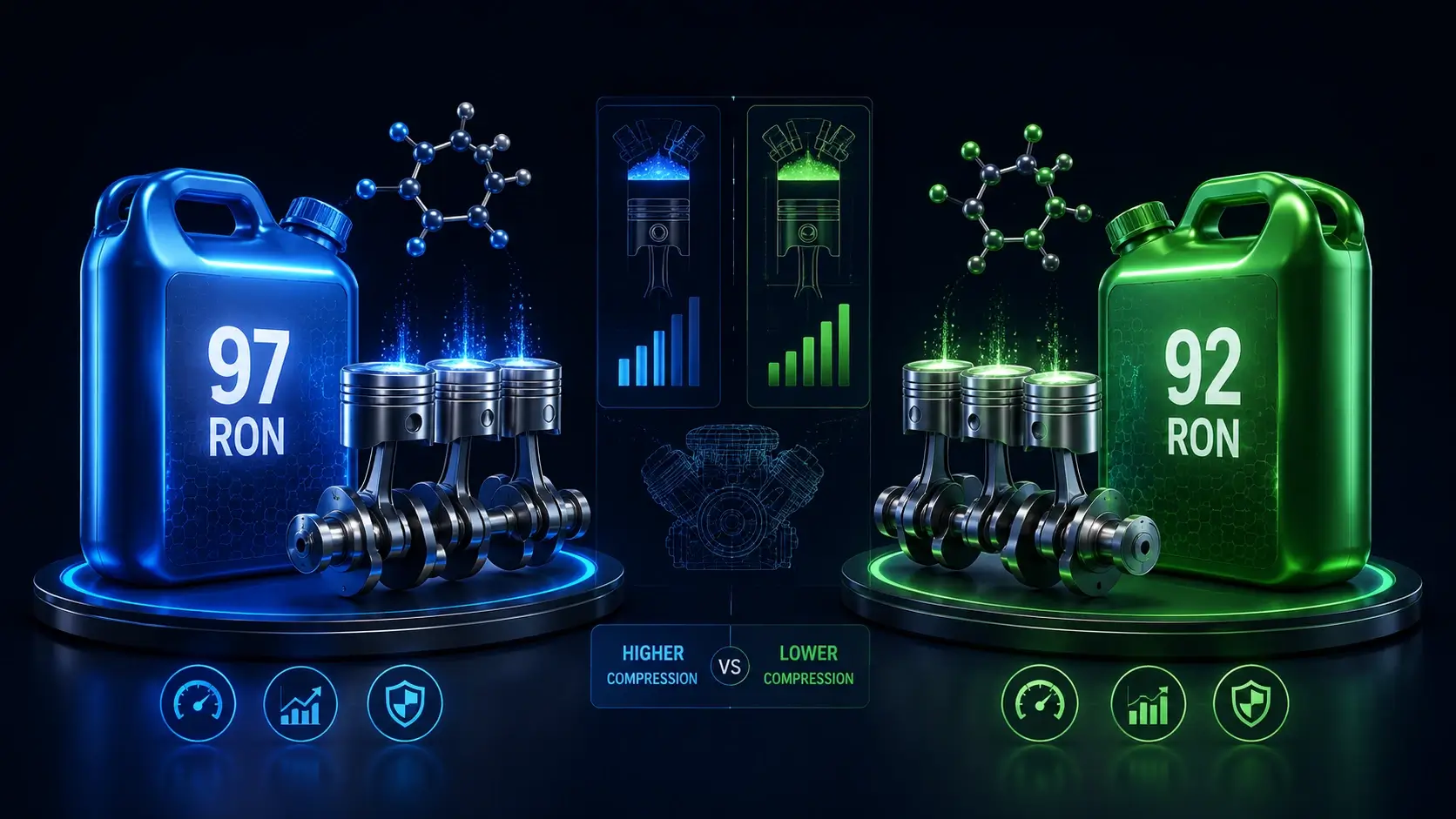
- Octane Is Knock Resistance, Not Raw Power: RON 97 resists premature ignition under high compression; it does not add horsepower to standard engines.
- Forced Induction Requirement: Turbocharged vehicles (Civic RS, Haval Jolion, Oshan X7, Sportage) require $\ge 95\text{ RON}$ to prevent ECU ignition timing retardation.
- Linear Blending Formula: A 50/50 mix of 92 RON Super and 97 RON HOBC delivers $\approx 94.5\text{ RON}$ at reduced cost.
LAHORE — With retail pump prices at historically elevated levels, Pakistani motorists face a common dilemma at the filling station: whether to use standard Super Petrol (92 RON), upgrade to premium High-Octane Blending Component (HOBC 97 RON), or blend both. Understanding the mechanics of Research Octane Number (RON) and engine compression ratios prevents unnecessary spending while protecting modern turbocharged engines from damaging knocking.
What Does Octane Rating (RON) Actually Mean?
A widespread misconception among drivers is that higher-octane fuel possesses more calorific energy and creates extra horsepower. In reality, Research Octane Number measures a fuel’s ability to resist auto-ignition under pressure. In high-compression or turbocharged engines, low-octane fuel can ignite prematurely before the spark plug fires—a destructive phenomenon known as engine knock or pre-ignition.
Which Vehicles in Pakistan Require High-Octane?
Naturally aspirated economy cars (such as the Suzuki Alto 660cc, WagonR, Cultus, and Toyota Yaris 1.3L) operate with moderate compression ratios. Running pure 97 RON in these engines provides no performance gain because the engine management system cannot advance ignition timing beyond factory parameters.
Conversely, modern direct-injection turbocharged engines (such as the Honda Civic RS 1.5T, Haval H6/Jolion, Changan Oshan X7, Chery Tiggo, and Hyundai Sonata 2.5) run under intense cylinder pressure. When supplied with pure 92 RON in extreme Pakistani summer heat, their Electronic Control Units (ECUs) detect knock and retard timing—reducing fuel economy and causing engine sluggishness.
The Economics of the 50/50 Blending Strategy
Because petrol octane scales linearly when mixed in a fuel tank, combining equal parts of 92 RON Super and 97 RON HOBC creates an effective rating of approximately 94.5 RON:
For owners of crossover SUVs (such as Kia Sportage, Hyundai Tucson, or Haval Jolion), a 50/50 blend satisfies the engine’s 95 RON requirement without paying full premium prices on a full tank. Check updated retail pump rates on our dedicated High-Octane (HOBC) Price Portal or model your monthly fuel budget on the Daily Commute Calculator.
4 thoughts on “”